From Beijing to Port Moresby by Virginia Domingues David Wu
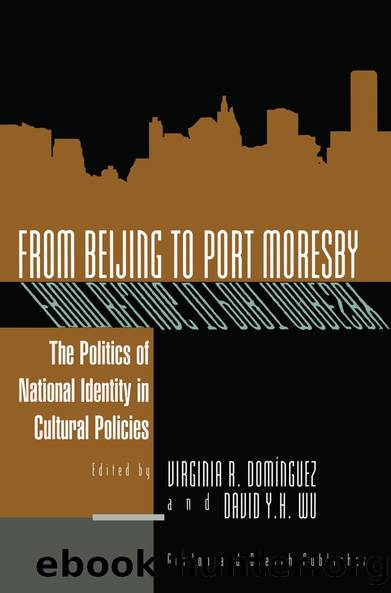
Author:Virginia Domingues, David Wu [Virginia Domingues, David Wu]
Language: eng
Format: epub
Tags: Nonfiction, Social & Cultural Studies, Social Science, Anthropology
ISBN: 9781134388738
Publisher: Taylor and Francis
Published: 2014-01-02T05:00:00+00:00
8
Cultural Diversity and Identity in Papua New Guinea: A Second Look
Wari Iamo and Jacob Simet
Lindstrom's chapter in this volume is representative of recent literature on nations and ethnic groups in the Pacific. The construction and maintenance of national identities and cultural policies has recently received considerable attention by Pacific scholars (Crocombe 1976; Foster 1991; Howard 1989; Keesing 1982,1989; Lindstrom 1982 and 1994, current volume; Loiskandl 1988). In this essay, we note such attention but also seek to comment on it.
Roger Keesing argued in 1982 that the process of colonialism was crucial in forcing a new sort of self-conscious reflection about their cultures on the part of colonized peoples. He wrote that it was perhaps "only the circumstances of colonial invasion, where people have had to come to terms with their powerlessness and peripherality, that allow such externalization of culture as symbol" (1982:301).
Indeed this process can be evidenced in many cases from the colonial and postcolonial experiences of Pacific nations. The effects of this externalization of culture as symbol have been manifested in several cases in the usage of native customs as organizing principles in the formation of national governments. In Vanuatu, the Solomon Islands, and Fiji, notions of "kastom" and "tradition" have been incorporated into the political and administrative structure of the nation-state where they are used with hegemonic force in dealings with local communities (Lindstrom 1990, White 1992). Although the Melanesian nations of Papua New Guinea, the Solomon Islands, and Vanuatu have no dominant cultural groups, elites in these nations have employed overarching notions of custom and tradition in attempts to unite diverse peoples.
The specific characteristics of Papua New Guinea as it exists today make the construction of a national cultural identity a challenging task. Its small population of 3.5 million is the most culturally and linguistically diverse in the world. If one arrives at the number of different ethnic groups solely on the basis of language, Papua New Guinea could be estimated to have 700 to 1000 such groups. If groups that share linguistic traits yet are differentiated by other cultural factors were enumerated, one could arrive at a figure approaching tens of thousands of distinct groups. Many geopolitical boundaries were demarcated by the colonial administration and were either redesigned, continued or eliminated by the nation's governments in ways that further complicate any attempt to enumerate the nation's peoples.
Download
This site does not store any files on its server. We only index and link to content provided by other sites. Please contact the content providers to delete copyright contents if any and email us, we'll remove relevant links or contents immediately.
Spell It Out by David Crystal(36116)
Life for Me Ain't Been No Crystal Stair by Susan Sheehan(35810)
Cecilia; Or, Memoirs of an Heiress — Volume 1 by Fanny Burney(32558)
The Great Music City by Andrea Baker(32018)
Cecilia; Or, Memoirs of an Heiress — Volume 2 by Fanny Burney(31956)
Cecilia; Or, Memoirs of an Heiress — Volume 3 by Fanny Burney(31941)
Professional Troublemaker by Luvvie Ajayi Jones(29661)
The Secret History by Donna Tartt(19085)
We're Going to Need More Wine by Gabrielle Union(19045)
Twilight of the Idols With the Antichrist and Ecce Homo by Friedrich Nietzsche(18632)
All the Missing Girls by Megan Miranda(16023)
Cat's cradle by Kurt Vonnegut(15351)
Pimp by Iceberg Slim(14506)
For the Love of Europe by Rick Steves(14121)
Bombshells: Glamour Girls of a Lifetime by Sullivan Steve(14073)
Talking to Strangers by Malcolm Gladwell(13370)
Norse Mythology by Gaiman Neil(13363)
Fifty Shades Freed by E L James(13239)
The Social Justice Warrior Handbook by Lisa De Pasquale(12190)
